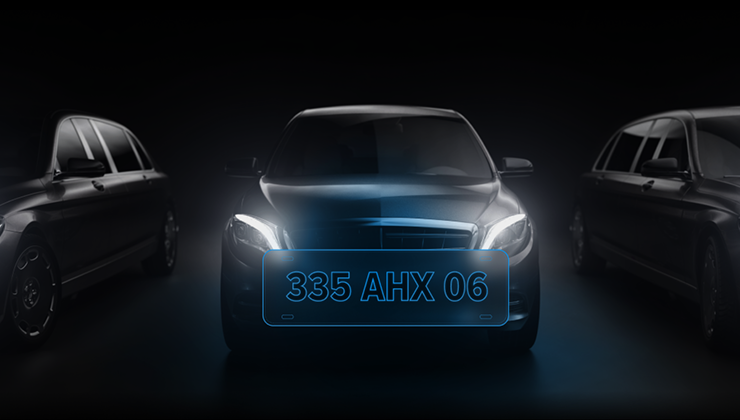
Supports EU, US and Canada plates
License plate recognition, proven at over 99% accuracy
Anyline puts license plate recognition into your own app, on any platform, mobile or web, with no new hardware to buy.
Anyline is trusted by




















Anyline is trusted by

















One Pass.
Every Plate.
AI license plate recognition scans continuously, reading one plate after another without a shot to line up or a wait in between. No manual entry, and no special hardware required.
Get the Trial App

Fast. Secure.
Trusted.
License plate data is processed and read on the device, even offline, and is not sent to the cloud, so vehicle and personal information stays secure.
Talk to an Expert
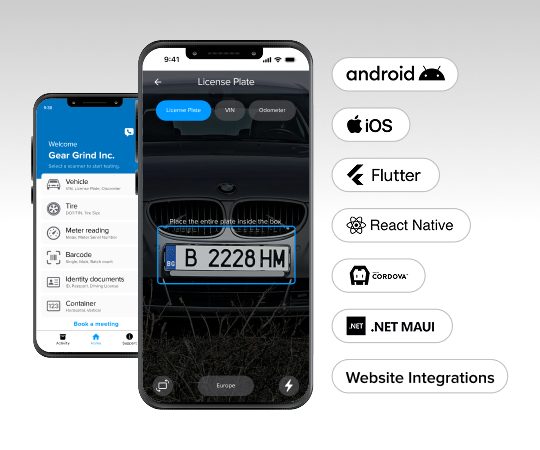
Flexible Integration
for Any Workflow
Connect license plate scanning to your apps, web tools, or partner platforms using our mobile or web SDK, fully compatible with iOS, Android, and common cross-platform frameworks.
Request a Demo
Over 99% accuracy across more than 100 million scans a year.

Multi-Region Coverage

Region Detection
Every plate matched to its region, no setup needed

Proven in the Field
Trusted in daily enforcement by parking operators and city governments
Commonly Asked License Plate Scanning Questions.
License plate recognition, or LPR, reads the characters on a vehicle’s plate from a camera image and returns them as text an application can use. The same capability is called ALPR in North America and ANPR in the UK and Europe.
An automatic license plate reader on a smartphone keeps the camera live and finds each plate in the frame by itself. There is no shot to line up, no upload and no wait for a server to answer. An officer walks a row and the phone captures plates as they come into view, one after another, and each result goes straight to your app. One pass covers every car parked along it.
Anyline reads plates with over 99% accuracy. A mobile engine works with the camera in your user’s hand, so the practical result depends on what that camera can see. A clean, well-lit plate at a reasonable angle reads reliably. Heavy dirt, snow, glare, physical damage or a novelty frame will cost you characters on any engine, so every read comes back with a confidence score and your app decides what to do with a low one. Anyline handles over 100 million scans a year.
Anyline reads plates from the EU, the US and Canada, and it detects the region automatically, so your app never has to ask a user where the car is registered. Within those regions the engine handles the everyday awkward cases, including two-line layouts and the wide variation in state and country designs. Plates from outside those three regions are worth checking with us before you build against them, because coverage is extended model by model.
Yes. Anyline’s plate scanning runs natively on iOS and Android, with wrappers for React Native, Flutter and Cordova, and a web SDK for JavaScript in the browser. One integration covers every device your field team carries, and the reads happen on the phone, so the app keeps working where there is no signal. The documentation has the install steps and the requirements for each platform.
Anyline licenses its plate scanning SDK annually, and each package is built around the customer’s own use case and scan volume. There is no hardware to buy since the SDK runs on the phones your team already carries. A permit enforcement app and a rental check-in flow have different volume profiles, so the two are quoted separately. The pricing page carries the current packages and the route to a quote.
Yes. Anyline is built with privacy by design. License plate data is processed directly on the end user’s device or browser. By default, no images or results are sent to Anyline servers, and the SDK can run fully offline, so vehicle and personal information stay inside your own system. That also means a plate read works in a basement level or a rural lot where the connection drops.